
What happens when you cross a worm with a robot?
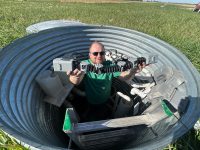
Inspired by the movement of worms, Dr. Tan and his research team developed a robotic system that can navigate corrugated agricultural drainage…
MSU Finding Creative Uses for Soft Robots
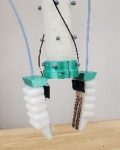
Dr. Tan and his research team are advancing soft robotics by developing flexible, biologically inspired robots that are inherently safe…
Vedant Naik Wins First Place at MSU Undergraduate Research Showcase
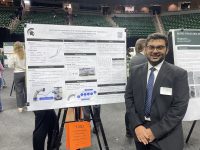
Congratulations to Vedant Naik for winning first place in the Engineering, Computer Science, and Math category at Michigan State University’s…

What happens when you cross a worm with a robot?December 12, 2025Inspired by the movement of worms, Dr. Tan and his research team developed a robotic system that can navigate corrugated agricultural drainage pipes by exploiting their ridged structure for locomotion. As the robot stretches and contracts through underground pipes, it evaluates their physical condition to enable early detection of potential issues, helping reduce repair costs for farmers. …
What happens when you cross a worm with a robot? Read More » [...]
Read more...
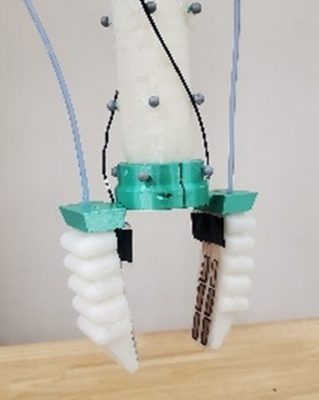
MSU Finding Creative Uses for Soft RobotsSeptember 26, 2025Dr. Tan and his research team are advancing soft robotics by developing flexible, biologically inspired robots that are inherently safe for humans and delicate environments. Their work explores applications such as underground agricultural drainage pipe inspection and soft robotic arms for harvesting and handling produce, where adaptability and gentle interaction are essential. Read the full …
MSU Finding Creative Uses for Soft Robots Read More » [...]
Read more...
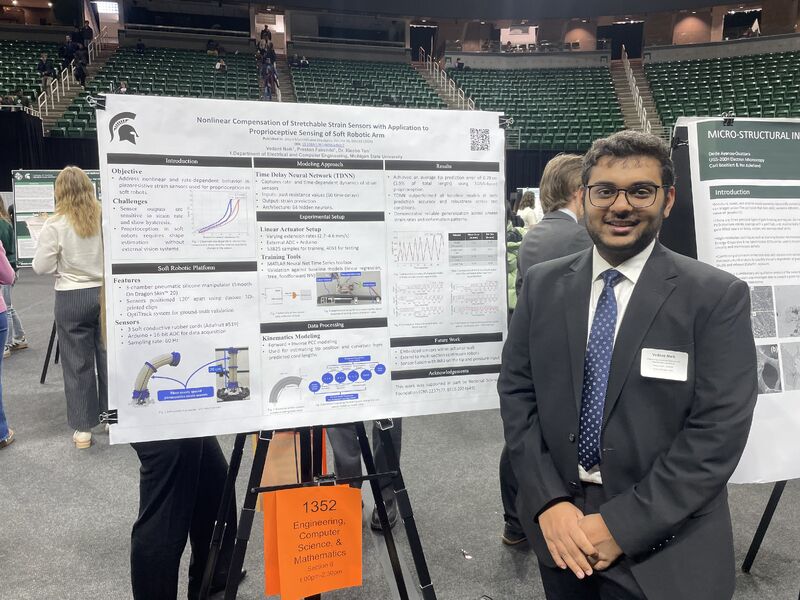
Vedant Naik Wins First Place at MSU Undergraduate Research ShowcaseApril 22, 2025Congratulations to Vedant Naik for winning first place in the Engineering, Computer Science, and Math category at Michigan State University’s 2025 Undergraduate Research and Arts Forum (UURAF). His award-winning poster was based on his paper, “Nonlinear compensation of stretchable strain sensors with application to proprioceptive sensing of soft robotic arm”, completed with support from the …
Vedant Naik Wins First Place at MSU Undergraduate Research Showcase Read More » [...]
Read more...

Dr. Tan gave keynote talk at 2025 IEEE Systems ConferenceApril 14, 2025Dr. Tan gave a keynote talk, entitled “Stalking vampires of the Great Lakes: A systems engineering solution for monitoring invasive sea lamprey with e-skins”, at the 19th Annual IEEE International Systems Conference (SysCon 2025). More information about his talk can be found at Keynote Speakers | SYSCON 2025. [...]
Read more...
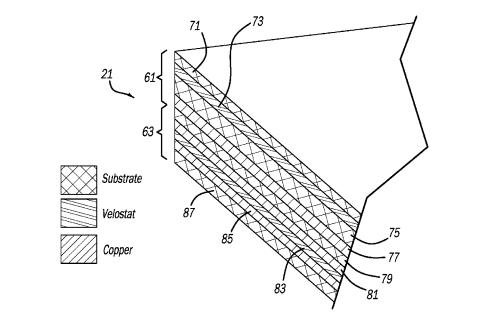
SML Awarded New Patent on Flexible SensorOctober 9, 2024SML was awarded a new patent on FLEXIBLE SENSOR. [...]
Read more...
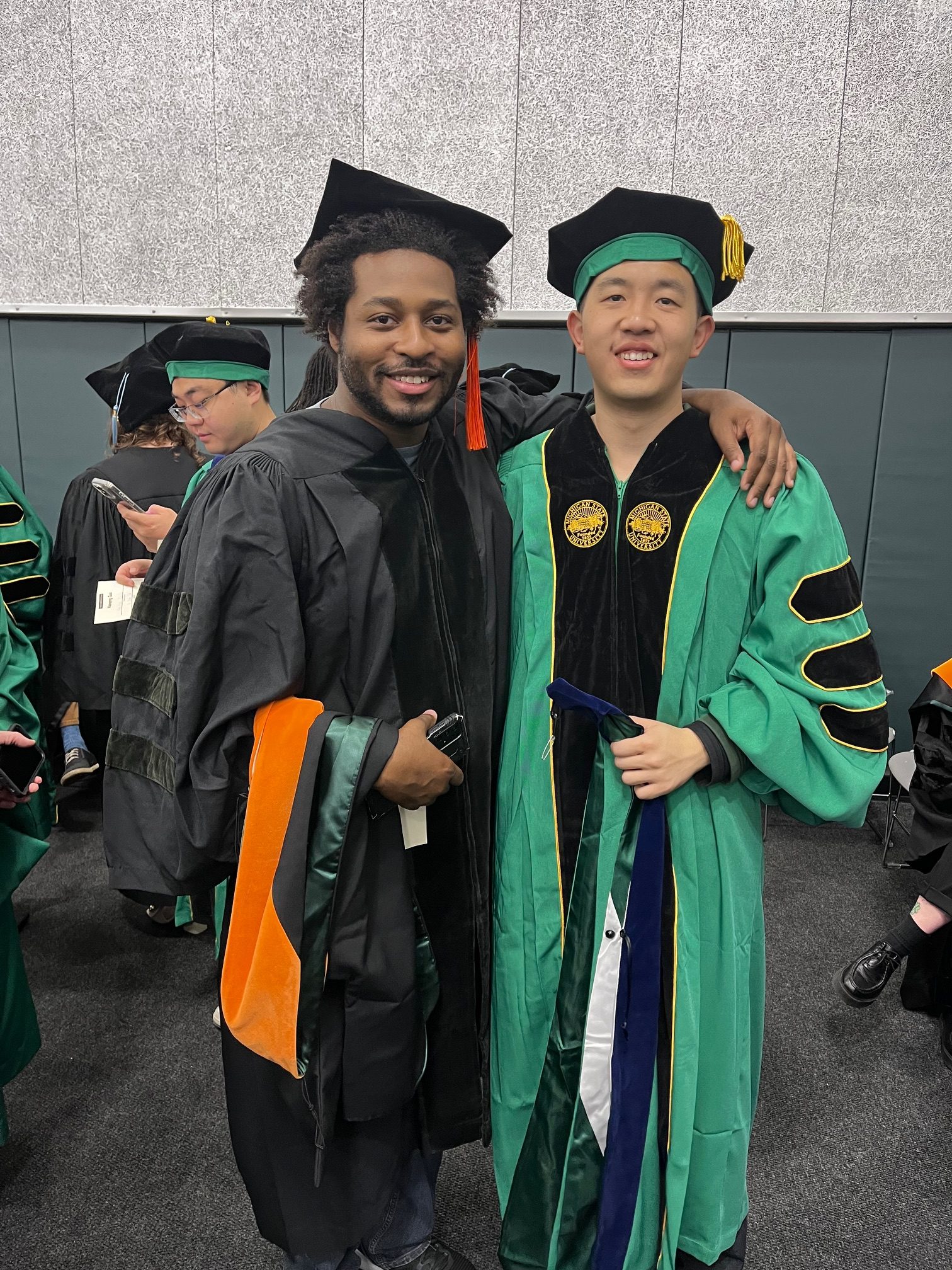
Xinda Qi Completed PhD Study and will be joining Amazon RoboticsOctober 9, 2024Congratulations to Xinda Qi, who has successfully completed his PhD study at Michigan State. His dissertation was titled “Bioinspired Soft Robots: Design, Modeling, and Control”. He will be joining Amazon Robotics as an Applied Scientist and work on robot motion planning and control. [...]
Read more...
Active Projects
Soft Robotic Systems for Safe and Accurate Medical Diagnosis and Intervention (MSU Foundation)September 15, 2020Sponsor: MSU Foundation (Strategic Partnership Grant)
PI: Prof. Xiaobo Tan, Co-PIs: Prof. Tong Gao (Mechanical Engineering and Computational Mathematics, Science and Engineering), John Kruger (Small Animal Clinical Sciences), Chunqi Qian (Radiology), Chuan Wang (Electrical & Computer Engineering).
This internal grant aims to build an interdisciplinary team at MSU that advances soft robotic systems for various applications, including addressing medical challenges, such as accessing hard-to-reach organs for medical imaging and interventions. The team consists of experts on soft robotics, computational modeling, electronic skins, MRI imaging, and animal clinical sciences. [...]
A Smart Panel System for In-situ Detection of Adult Sea Lamprey (Great Lakes Fishery Commission)September 15, 2020Exploiting the Unexploited: A Smart Panel System for In-situ Detection of Adult Sea Lamprey
Sponsor: Great Lakes Fishery Commission (Sea Lamprey Research Program)
PI: Prof. Xiaobo Tan, Co-PIs: Christopher Holbrook (Hammond Bay Biological Station, U.S. Geological Survey), and Chuan Wang (Electrical & Computer Engineering).
Invasive species control and assessment strategies often seek to exploit species-specific behaviors or traits. Simply put, adult sea lampreys suck like no other organisms in the Great Lakes. However, this characteristic has not been directly exploited to enumerate or control sea lampreys. A low-cost smart panel capable of sensing, recording, and possibly responding to sea lamprey attachment could enhance selective fish passage devices (e.g., triggering localized electrical stimulus to repel or deter a lamprey), spearhead new research to address critical gaps in sea lamprey life history and ecology (e.g., refuge-seeking behavior and habitat characteristics, stream entry timing), and have broad-ranging applications to sea lamprey assessment and control (e.g., new trapping system design).
This project aims to design, develop, and test a low-cost portable smart panel system that autonomously (1) senses when an adult sea lamprey has attached to the panel, (2) records and transmits event data (time, pressure statistics, event duration), and (3) triggers auxiliary mechanisms, for example, activating a localized electric field to repel the attached lamprey. The proposed smart panel will have a modular architecture – they can be deployed individually at spots of interest (stream entries, trap sites, refuge habitats) or assembled into a larger panel for deployment at places like dams. The panel could incorporate an attractant (e.g., pheromone polymer emitter) to enhance encounter and attachment rate. Wireless cellular data module could remotely transfer data in near real-time from field to office. [...]
Circuit Dynamics of Sensorimotor Integration and Decision Making in Octopus (NIH)September 15, 2020https://msutoday.msu.edu/news/2020/no-bones-about-it-octopus-may-be-the-key-to-smart-prosthetics/ [...]